Categories
-
ANU Africa Network
Posted on
by
This website was established in 2013 by David Lucas, and renovated and relaunched in 2020 as part of a project to increase awareness of Africa and African studies in the ANU and the ACT, funded by the Australian Government’s Department of Foreign Affairs and Trade.
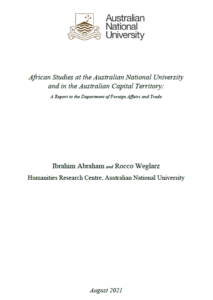
Another outcome of that project was a major research report, published in August 2021, African Studies at the Australian National University and in the Australian Capital Territory, analyzing the past, present and future of the study of Africa at the Australian National University and the wider Australian University sector.
The major innovation on this updated website is the creation of the ACT Africa Expert Directory which lists experts on Africa from institutions around the ACT, primarily the ANU. We will continue to curate this list, offering a key resource for media, government and non-government organizations seeking expert facts and opinions on Africa. Individuals can request to be added to the list by contacting the website managers.
Another notable addition is the expanded directory of PhD theses on Africa produced in the territory’s universities, a solid measure of the vitality of the study of Africa in the city of Canberra.
Reviewing these directories, it is revealing to note that the vast majority of research on Africa is produced by disciplinary experts (environmental scientists, economists, demographers, etc.) rather than area studies experts. This means that the study of Africa is woven into the fabric of the research culture of the ANU and the ACT’s other universities in ways that are not necessarily apparent.
-
Namibian President Hage Geingob dies at age 82
Posted on
by
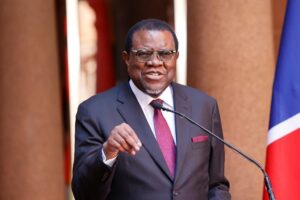
Namibia is plunged into sorrow as the nation mourns the passing of President Hage Geingob at the age of 82. Having led the country since 2015, President Geingob succumbed to cancer at the Lady Pohamba Hospital in Windhoek, where he had been undergoing treatment.
In reflection of this significant loss, we extend our heartfelt condolences and hope that the departed president finds rest.
What do we know about Namibia?
Namibia’s rich political history encompasses its colonization by Germany in 1884, followed by occupation by South Africa in 1915. After World War II, South Africa annexed the territory and administered it as a mandate until 1988. The journey to independence was marked by the SWAPO guerrilla group’s war of independence, culminating in Namibia gaining its sovereignty in 1990.
SWAPO, now the ruling party, has transitioned from its Marxist roots over the years. President Hage Geingob assumed office in 2015, succeeding Hifikepunye Pohamba, who had served two terms. Geingob’s initial landslide victory in 2014 was followed by his reelection in 2019, albeit with a reduced majority. This marked a shift, as SWAPO narrowly lost its parliamentary supermajority in the same elections.
As we reflect on Namibia’s current state, the nation boasts a population of approximately 2.7 million (2023 est.), with an urbanization rate of 54.9% and a life expectancy of 63.7 years (2023 est.). The GDP stands at $12.372 billion (2019 est.), with a per capita income of $9,100 (2021 est.). According to the World Bank, Namibia is an upper-middle-income country. Namibia achieved this through its resource wealth (mostly gold and uranium), political stability, and sound macroeconomic management. A 2023 ranking by Yahoo Finance put Namibia 12th among the richest countries in Africa by GDP per capita.
-
Kirsty Wissing returns to ANu and Rachael Gross continues
Posted on
by
Dr Kirsty Wissing, whose ANU thesis was on water in Ghana, has
returned to Canberra on a 3-year ANU-CSIRO research fellowship considering Indigenous water values and flood mitigation strategies in the Northern Rivers region in NSW.
She is housed in the School of History, Culture and Language in the Coombs Building, ANU, and at the CSIRO.
.
-
Africa seen as an important future source of international students
Posted on
by
A report by The Lygon Group, commissioned by Universities Australia, suggests that by 2050, the nations of sub-Saharan Africa will be the “new China and perhaps India” – Australia’s current top two sources for international students.
“Meanwhile, the continent of Africa is projected to change in the opposite direction with a steady growth in the percentage of working-age people,” the report reads.
“Education will be key to ensuring the continent’s trajectory is to achieve the goal of ‘getting rich before it gets old’.”