
Categories
-
ANU Africa Network
Posted on
by
This website was established in 2013 by David Lucas, and renovated and relaunched in 2020 as part of a project to increase awareness of Africa and African studies in the ANU and the ACT, funded by the Australian Government’s Department of Foreign Affairs and Trade.
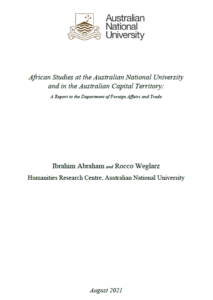
Another outcome of that project was a major research report, published in August 2021, African Studies at the Australian National University and in the Australian Capital Territory, analyzing the past, present and future of the study of Africa at the Australian National University and the wider Australian University sector.
The major innovation on this updated website is the creation of the ACT Africa Expert Directory which lists experts on Africa from institutions around the ACT, primarily the ANU. We will continue to curate this list, offering a key resource for media, government and non-government organizations seeking expert facts and opinions on Africa. Individuals can request to be added to the list by contacting the website managers.
Another notable addition is the expanded directory of PhD theses on Africa produced in the territory’s universities, a solid measure of the vitality of the study of Africa in the city of Canberra.
Reviewing these directories, it is revealing to note that the vast majority of research on Africa is produced by disciplinary experts (environmental scientists, economists, demographers, etc.) rather than area studies experts. This means that the study of Africa is woven into the fabric of the research culture of the ANU and the ACT’s other universities in ways that are not necessarily apparent.
-
2021 RDI Development Futures Workshop Series
Posted on
by
For more information about the RDI Network see https://rdinetwork.org.au/about-us
‘In the wake of significant challenge and disruption driven by the COVID-19 pandemic, the RDI Network aims to generate in-depth conversations about development effectiveness and the future of aid and development. The far-reaching effects of the pandemic have also compounded the effects of other recent changes in global aid and the Australian development industry. These changes include the rise of the private sector, climate change, growing instability, trust in institutions and renewed calls for genuine localisation processes.
We understand that development and humanitarian practice do not take place in a vacuum – that they are informed and influenced by the context in which they occur. Yet the day-to-day lives and schedules of policy makers and implementers often leave little room to question and debate current development directions, or systematically explore ideas guiding programming.
Our 2021 Development Futures Workshop Series aims to create space for those working or teaching in international development and humanitarian aid to deconstruct, discuss, and debate potential trends, hazards and challenges affecting the sector, and reimagine future development solutions.
The Research for Development Impact Network (RDI Network) is calling for expressions of interest from international development and humanitarian practitioners to participate in our Development Futures Workshop Series in 2021.
RDI Network is calling for interested organisations to nominate two to three individuals to attend one of our Development Futures Workshop Series. We encourage organisations to nominate a diverse mix of staff, board members and/or key stakeholders to apply for this workshop series. Individuals are also welcome to submit an expression of interest.
The RDI Network values the experience and contribution of people from all cultures, genders, bodies and abilities. Ideal participants will have an open-minded approach, a willingness to be challenged and a commitment to engaging with insights from outside their own perspectives and areas of expertise.
Flexibility, including a willingness to recognise, accept and analyse a rapidly changing environment will be key. All participants will also require reliable internet access.’
For more information see
https://rdinetwork.org.au/news/eoi-development-futures-workshop-series/?mc_cid=c215f7198e&mc_eid=fe20e3678a
-
Belle Low’s funeral
Posted on
by
The obituary of former ANU Vice-Chancellor Anthony Low was published on this weblog of 28/11/2015:
‘Anthony’s illustrious academic career began in 1951 as a Lecturer at Makerere College, University of East Africa. While undertaking archival research in Zanzibar he met Isobel Smail who was nursing in the Protectorate and was proficient in Swahili. They were married in Zanzibar Cathedral in 1952, celebrating their 60th anniversary in 2012.’
Belle Low was one of the last connections with the generation of Africanists that flourished in Canberra post-War.
Her funeral service will be at St John’s, Constitution Avenue, Reid, ACT, at 10.30, Friday 4th December’
The service will be livestreamed and the
the link is: https://funeralstre.am/isobel-low
-
Decolonizing the University: Conversations across the Creek
Posted on
by
Friday, 09 October 2020, 1–2pm, Online webinar (registration required)
 Arguing that the institution of the university has been broadly complicit with colonialism, the call to “decolonize” universities and academic practices has been heard across the world, from Cape Town to Oxford to Canberra. But what exactly does it mean to “decolonize” the university or to “decolonize” science or the humanities? This webinar will present a range of views on decolonization and the university by scholars from across the natural sciences, social sciences and the humanities, focusing on local and global challenges to prevailing academic practices.
Conversations Across the Creek is an initiative of the Humanities Research Centre and the Research School of Chemistry. These events provide a space for continuing dialogue among scientists, social scientists, and humanities scholars, with the aim of stimulating and unearthing collaborations across the university and between the university and the community.
Speakers
Dr Ibrahim Abraham (Humanities Research Centre)Dr Karo Moret Miranda (School of History)Ms Maeve Powell (Crawford School)Mr Sam Provost (Fenner School)
