
Categories
-
ANU Africa Network
Posted on
by
This website was established in 2013 by David Lucas, and renovated and relaunched in 2020 as part of a project to increase awareness of Africa and African studies in the ANU and the ACT, funded by the Australian Government’s Department of Foreign Affairs and Trade.
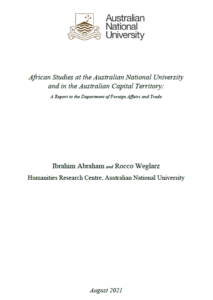
Another outcome of that project was a major research report, published in August 2021, African Studies at the Australian National University and in the Australian Capital Territory, analyzing the past, present and future of the study of Africa at the Australian National University and the wider Australian University sector.
The major innovation on this updated website is the creation of the ACT Africa Expert Directory which lists experts on Africa from institutions around the ACT, primarily the ANU. We will continue to curate this list, offering a key resource for media, government and non-government organizations seeking expert facts and opinions on Africa. Individuals can request to be added to the list by contacting the website managers.
Another notable addition is the expanded directory of PhD theses on Africa produced in the territory’s universities, a solid measure of the vitality of the study of Africa in the city of Canberra.
Reviewing these directories, it is revealing to note that the vast majority of research on Africa is produced by disciplinary experts (environmental scientists, economists, demographers, etc.) rather than area studies experts. This means that the study of Africa is woven into the fabric of the research culture of the ANU and the ACT’s other universities in ways that are not necessarily apparent.
-
Sudan Photos in the The Art of Anthropology Art Exhibition;
Posted on
by
The Art of Anthropology Art Exhibition
Venue
The Gallery, China in the World Building (188), Fellows Lane, ANU
Dates
2nd Oct- 20th Oct, 9-5pm,“The Art of Anthropology showcases the photographs of 31 ANU anthropologists taken during their research “in the field” in various places around the world. The exhibition is a
window into the beauty and dynamics of ethnographic inquiry, highlighting the multiplicity and diversity of research methodologies that anthropologists use in their work. It is a way for ANU anthropologists to communicate their research visually and an opportunity for those outside the discipline to gain an insight into the richness and diversity of the human experience.”More information:
https://asiapacific.anu.edu.au/cap-events/2017-09-29/art-anthropology
Included is the work of Paul Hayes on Sudan
Fellow PhD candidate Paul Hayes’ research explores the migration patterns of the Nuba people of Sudan, who have been involved in protracted armed conflict with the north Sudanese regime. Seeking safety, many Nuba people have migrated to the Sudanese capital of Khartoum.
Paul says, however, that not all the Nuba in Khartoum are there to escape the effects of the war. Some are labour migrants who travel back and forth, and yet others have remained in the Nuba mountains.
“The situation in Sudan seemed to share similarities with a couple of other anthropological studies of wartime migration in Afghanistan and Mozambique, where it is difficult to distinguish between a labour migrant and a forcibly displaced person,” he says.
“Through interviews, and extensive participant observation in the Nuba community in Khartoum, I want to get a sense of the role migration plays in people’s lives, livelihoods and identities, how decisions are made about whether and when to migrate – in wartime and in peace.”
His photos were taken at a stadium in Khartoum, where the Nuba wrestle competitively. It’s a location Paul found to be a good field site.
“These weekly wrestling matches are kind of a convenient place for a foreigner to hang out and meet lots of people, because they’re open to the public
https://www.anu.edu.au/news/all-news/photography-exhibition-showcases-global-reach-of-anu-anthropology
”
-
Intensive and extensive margins of mining and development: evidence from Sub-Saharan Africa
Posted on
by
Intensive and extensive margins of mining and development: evidence from Sub-Saharan Africa
Crawford School of Public Policy | Arndt-Corden Department of Economics
ACDE Trade & Development SeminarsDate & time
Tuesday 26 September 2017
2.00pm–3.30pm
Venue
Seminar Room C, Coombs Building, Fellows Road, ANUSpeaker
Sambit Bhattacharyya, Sussex University.Contacts
Ross McLeod
seminars.economics@anu.edu.au“What are the economic consequences of mining in Sub-Saharan Africa? Using a panel of 3,635 districts from 42 Sub-Saharan African countries for the period 1992 to 2012 we investigate the effects of mining on living standards measured by night-lights. Night-lights increase in mining districts when mineral production expands (intensive margin), but large effects approximately equivalent to 16 per cent increase in GDP are mainly associated with new discoveries and new production (extensive margin). We identify the effect by carefully choosing feasible but not yet mined districts as a control group. In addition, we exploit giant and major mineral discoveries as exogenous news shocks. In spite of the large within district effects, there is little evidence of significant spillovers to other districts reinforcing the enclave nature of mines in Africa. Furthermore, the local effects disappear after mining activities come to an end which is consistent with the ’resource curse’ view.”
-
The Francophone Africans: A Last Frontier for Australia
Posted on
by
The Francophone Africans: A Last Frontier for Australia
DATE:Tue, 17 Oct 2017
18:00 – 19:00. Refreshments available from 5.30 pm.VENUE: AIIA (ACT Branch), Stephen House, 32 Thesiger Court, Deakin ACT
SPEAKER
Mr William Fisher is the Special Envoy of the Australian Government for the Francophone States of Africa and La Francophonie. He is a former Australian senior diplomat. Mr Fisher is currently a Visiting Fellow at the College of Diplomacy at the Australian National University.
ABSTRACT
While Africa in general, and the French-speaking part of it in particular, may seem of distant interest to Australian preoccupations, there is an increasing number of issues where Australia will find it needs constructive partners in this region. The 24 Francophones constitute about half of the African bloc, and thus are an essential group in any contested UN vote, where they can act quite efficiently as a bloc. Each country is quite different, and state governance issues are often complicated. Terrorist threats can dominate in several, particularly the Sahel countries, while much of central and equatorial Africa suffers from years of often violent political instability and poor development outcomes. The Indian Ocean states, while not immune from political troubles of their own in the past, are generally now doing rather well. Australia has no assets in the region, and no resident Embassies other than, from just this month, Morocco.
COST: Free for AIIA members, $10 for non-members, $5 students. Payable at the door.