Categories
-
ANU Africa Network
Posted on
by
This website was established in 2013 by David Lucas, and renovated and relaunched in 2020 as part of a project to increase awareness of Africa and African studies in the ANU and the ACT, funded by the Australian Government’s Department of Foreign Affairs and Trade.
Another outcome of that project was a major research report, published in August 2021, African Studies at the Australian National University and in the Australian Capital Territory, analyzing the past, present and future of the study of Africa at the Australian National University and the wider Australian University sector.
The major innovation on this updated website is the creation of the ACT Africa Expert Directory which lists experts on Africa from institutions around the ACT, primarily the ANU. We will continue to curate this list, offering a key resource for media, government and non-government organizations seeking expert facts and opinions on Africa. Individuals can request to be added to the list by contacting the website managers.
Another notable addition is the expanded directory of PhD theses on Africa produced in the territory’s universities, a solid measure of the vitality of the study of Africa in the city of Canberra.
Reviewing these directories, it is revealing to note that the vast majority of research on Africa is produced by disciplinary experts (environmental scientists, economists, demographers, etc.) rather than area studies experts. This means that the study of Africa is woven into the fabric of the research culture of the ANU and the ACT’s other universities in ways that are not necessarily apparent.
-
The Individual Deprivation Measure South Africa Country Study Results
Posted on
by
Helen Suich, Senior Research Fellow, Crawford School of Public Policy (ANU)
The Individual Deprivation Measure, or IDM, is an individual-level, gender sensitive measure of multidimensional deprivation—it measures deprivation at the individual rather than household level, and is designed to discern differences in the experiences of poverty between men and women. The IDM program was a partnership between the ANU, the International Women’s Development Agency and the Australian Department for Foreign Affairs and Trade. The ANU led a studies in Indonesia in 2018 and in South Africa in 2019. The IDM programme ran between 2016 and 2020, and related research is being taken forward as the Individual Measurement of Multidimensional Poverty at ANU.
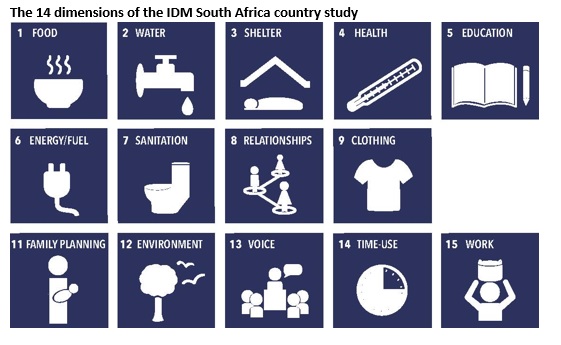
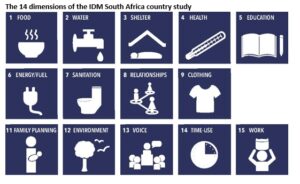
In South Africa, 14 dimensions of deprivation were measured (shown in the figure below). Some of these are already partially covered in some existing surveys (e.g. food security and access to drinking water), but the IDM includes a range of economic and social aspects which are not usually covered (e.g. the relationships, clothing and footwear and voice dimensions). Further, several IDM dimensions include aspects beyond that which is typically assessed. For example, the work dimension covers not only issues around paid work, but also includes themes on unpaid domestic and care work and on the double labour burden that can arise when both paid and unpaid work are done.
 The South African country study had two parts:
- a national-level main sample, that interviewed 8,652 individuals, 16 years and older;
- a purposive sample that interviewed 826 individuals with disabilities and their household members (2,311 individuals in total), in Gauteng and Limpopo provinces.
There are a wide range of resource available for those who are interested in the results of the survey and the methods used for the analysis.
A revised analysis of the data was undertaken, using slightly different methods, and a series of briefing notes and documentation was produced. There are six briefing notes, describing the results for the main sample, as well as the analyses by gender, by age group, by disability status and by rural/urban locality. The sixth summarises the South African country study and the revised data analysis methods. Accompanying documentation includes reports describing the revised methods in detail, as well as providing all of the revised results. A comprehensive report published in May 2020 summarises the initial analysis of both the main sample and the purposive sample, which is available here.
There is also a series of videos, one summarising the South African country study, one for the overall results of the main sample, based on the revised analysis methods, and one each describing the results by gender, age, rural/urban locality and disability status.
A launch of the report was held in early August 2020, with Australia’s High Commissioner to South Africa, Ms Gita Kamath, and the Resident Coordinator of the United Nations in South Africa, Nardos Bekele-Thomas, which you can watch below.
-
Cheeseman on How to Rig an Election and Get Away with It.
Posted on
by
AFSAAP Secretary Margaret O’Callaghan, has been sent this lecture recording by Nick Cheeseman this from the University of Manchester and comments, ‘it’s an hour long but well worth listening to with many country specific examples.’ In his co-authored book, How to Rig an Election, he argues “[c]ontrary to what is commonly believed, authoritarian leaders who agree to hold elections are generally able to remain in power longer than autocrats who refuse to allow the populace to vote.”
Nic Cheeseman visited the ANU in 2018.